Quick Answer
In one sentence: Self-monitoring is cheaper on the sticker but not free once you count the forfeited insurance discount, possible cloud and cellular gaps, and the fact that you become the one who has to respond, so the right choice depends on your availability, not just the monthly fee.
The longer answer: Professional monitoring typically runs somewhere around $20 to $60 a month, and self-monitoring can be free, so the naive comparison ends there. But that comparison leaves out real costs on the self-monitoring side, and it ignores that self-monitoring in 2026 is genuinely good for the right household. This is not a case for spending more. It is a case for counting honestly, so you pick the option that actually fits how you live.
Key Takeaways
- Professional monitoring costs roughly $20 to $60 a month; self-monitoring can be free or very low cost.
- Self-monitoring usually forfeits the home insurance discount, which narrows the real saving.
- 'Self-monitored' does not always mean no fee: cloud video can cost extra, and many such systems lack cellular backup.
- With self-monitoring, you are the monitoring center, which fails exactly when you cannot respond.
- An on-demand option lets you self-monitor day to day and call in professionals only when you travel.
Type this question into any search bar and the answer comes back fast: self-monitoring is free, professional monitoring costs money, done. That answer is not wrong, exactly, but it is incomplete in a way that can cost you. The real comparison is not just the monthly fee. It is what each option quietly adds or takes away around that fee. For the full picture of everything a system costs, our guide to what a home security system really costs has the total math; here we focus on this one decision.
What Self-Monitored Actually Means
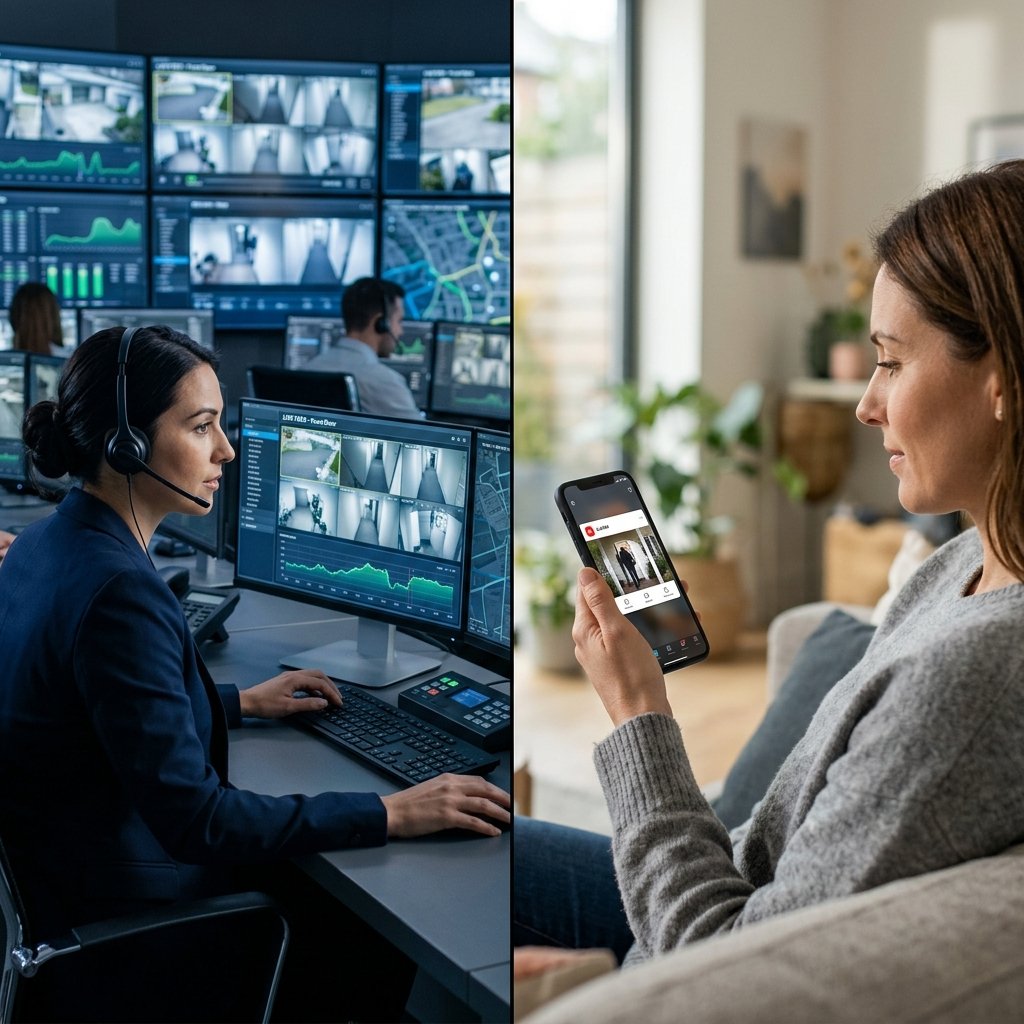
The two models differ in one fundamental way: who watches, and who acts.
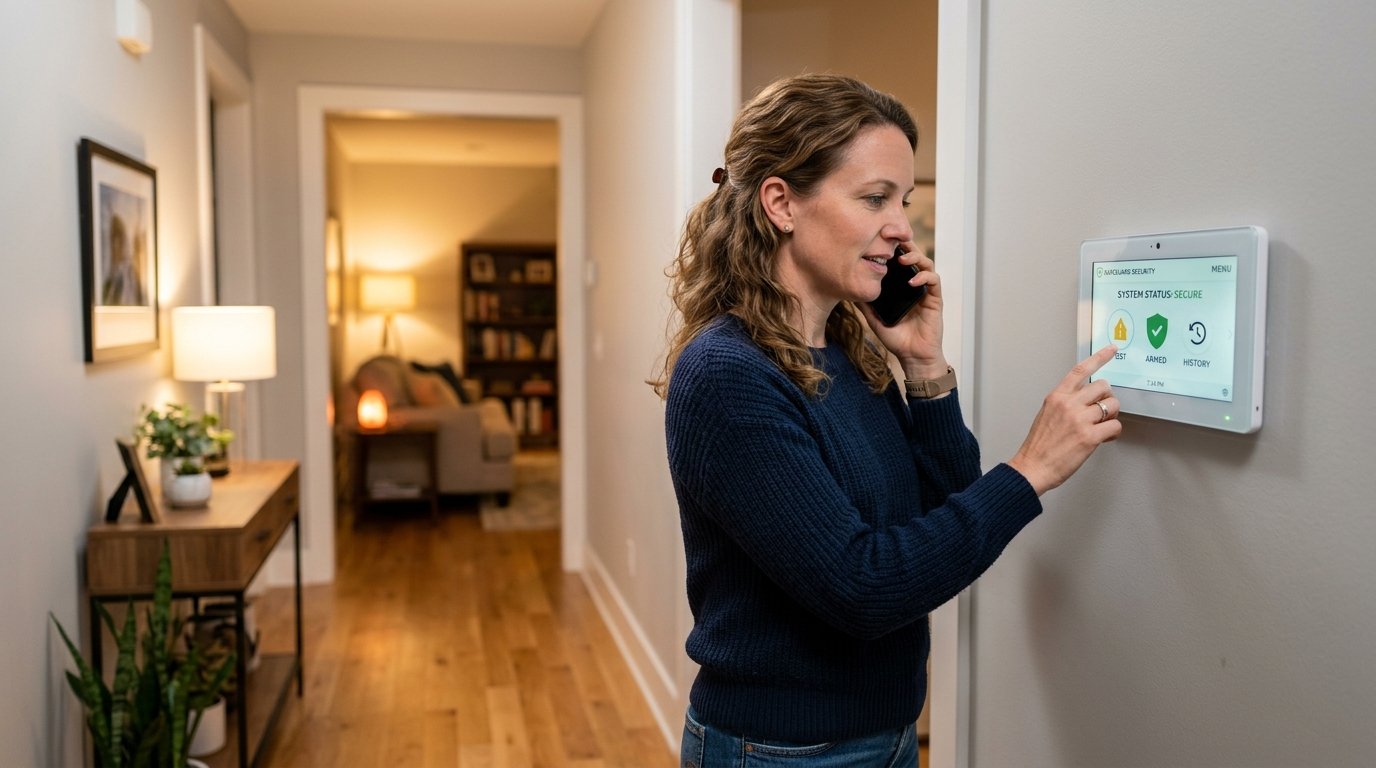
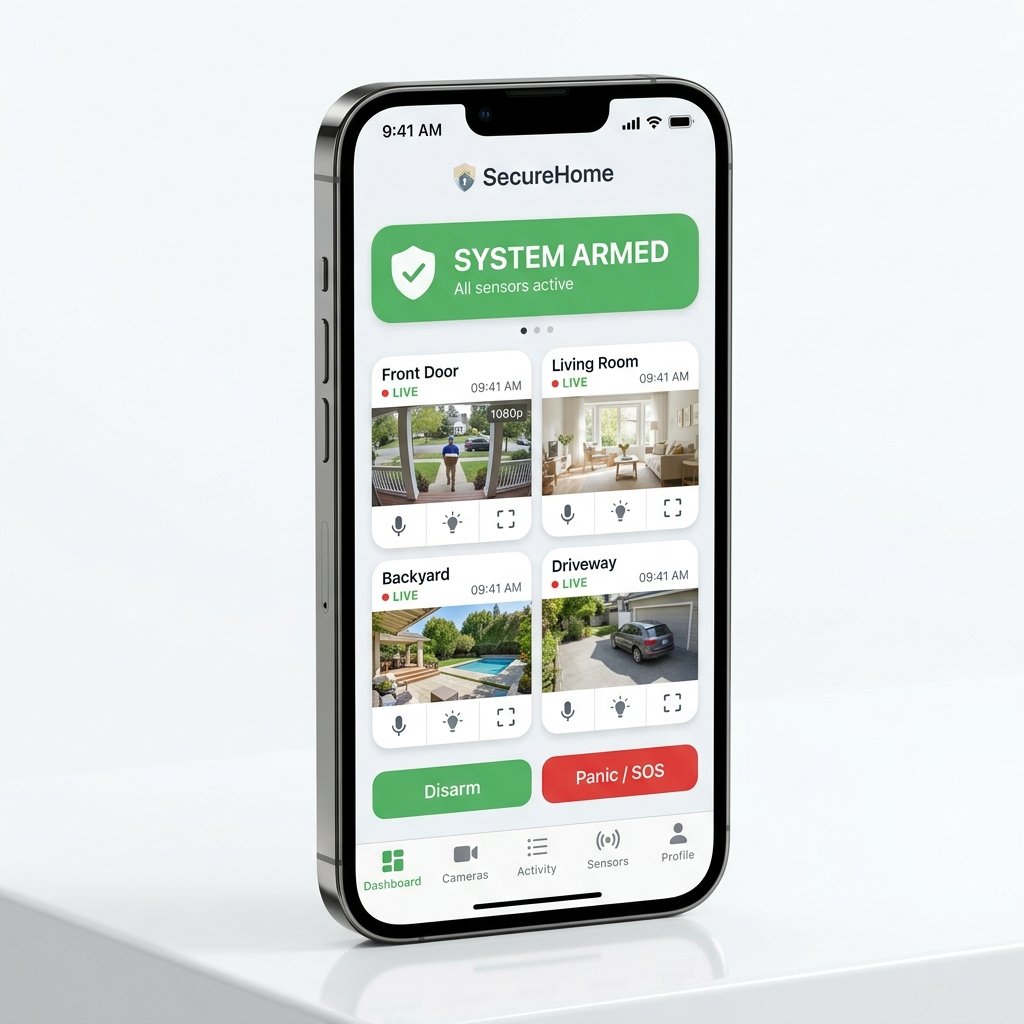
With self-monitoring, you are the monitoring center. When a sensor trips or a camera detects motion, a push notification arrives on your phone, and you decide what to do: check the feed, call for help, or dismiss it. Consumer security guidance describes this plainly as being in complete control, and also completely responsible.
With professional monitoring, a staffed center watches your system around the clock and dispatches police or fire when an alarm is verified, whether you are awake, reachable, or not. Our guide to 24/7 professional monitoring walks through exactly how that response works.
That single difference, who acts on an alert, is where all the real costs and benefits come from.
The Sticker Price Says Self-Monitoring Wins
On the headline numbers, it is not close. Professional monitoring is a recurring fee, commonly reported in the range of $20 to $60 a month, though some plans run higher. Self-monitoring can genuinely be free on systems that support it, with alerts going straight to your phone at no monthly cost.
Over a few years, that difference adds up to real money, and for a budget-conscious household it is a completely fair reason to choose self-monitoring. If the monthly fee were the only factor, the article would end here. It is not, because two of those apparently free setups are not as free as they look, and one large cost never appears on any price tag at all.
The Three Costs the Sticker Hides
1. The insurance discount you usually forfeit
Many home insurers offer a discount for a monitored system, but that discount typically requires professional monitoring, not self-monitoring, because the insurer wants assurance that someone will respond. Our guide to insurance discounts covers the detail, but the effect here is simple: choosing self-monitoring often means giving up a discount that could be worth a meaningful amount a year, which narrows the gap between the two options.
2. The 'free' that is not always free
Self-monitored does not automatically mean no monthly fee. On many systems, saving your camera footage to the cloud is a paid add-on, sometimes a small one and in some cases reported as high as around $75 a month for premium tiers. Just as important, a lot of self-monitored and no-fee systems do not include cellular backup at all, which means if your internet or power drops, the system may go silent. Professional plans typically bundle that cellular path, and our guide to testing your system explains why the backup connection matters so much.
3. You become the single point of failure
This is the cost that never shows up in a price comparison, and it is the biggest. Self-monitoring works beautifully right up until the moment you cannot respond. Consumer reviews make the point directly: there is no telling when an urgent alert will land, and it might be while you are asleep, in a meeting, on a plane, or out to dinner with your phone in your bag. And in the worst case, during a break-in at home, you may be the last person able to calmly call for help. A monitoring center has none of those gaps.

Want Help Weighing the Trade for Your Situation?
Our advisors can walk through the true cost of each option for how you actually live, and compare plans across our provider partners. Free consultation, no pressure.
Call (855) 248-8052 or Request a Free QuoteThe Real Cost Comparison
Set the two side by side with the hidden factors included, and the honest picture looks like this.
| Factor | Self-monitored | Professionally monitored |
|---|---|---|
| Monthly fee | Free to low | About $20 to $60 |
| Cloud video storage | Often a paid add-on | Usually included |
| Cellular backup | Frequently absent | Typically included |
| Insurance discount | Usually not eligible | Commonly eligible |
| Who responds | You | A staffed center, 24/7 |
| When you cannot respond | No response | Response still happens |
| Speed of response | Depends on you | Typically faster, verified |
| Control | Total | Shared with the center |
Read down the table and the trade is clear. Self-monitoring wins on cost and control. Professional monitoring wins on coverage when you are unavailable and on the response itself. Neither wins outright, which is exactly why this is a decision and not a verdict.

When Self-Monitoring Is Genuinely the Right Call
It would be dishonest to steer everyone toward the paid option, because for a lot of households self-monitoring is the smarter choice, and it has improved a great deal. Consumer guidance notes that in 2026 self-monitoring has become genuinely capable, with fast notifications and better smart detection, so many homeowners do not need a center watching their feed.
Self-monitoring tends to fit best when: you are home most of the time, you are comfortable acting on alerts, you keep your phone on and with you, your budget is tight, or you live somewhere lower-risk and mainly want awareness and a record of events. In those cases, paying a monthly fee for a center to do what you are already positioned to do yourself is a fair thing to skip.
If you go this route, close the obvious gaps: enable local or cloud recording so you keep evidence, as our guide to security cameras covers, and check whether any cellular backup is available, since that is the weak point of most self-monitored setups.
The Middle Path Most People Miss
Here is the option that rarely comes up, and it dissolves a lot of the dilemma: on-demand monitoring.
Some systems let you self-monitor day to day, then call in professional monitoring only when you need it, for example while you are on vacation or traveling for work. On certain plans you can even review an alert yourself and manually forward it to the monitoring center to act on. That means you can pay little or nothing most of the time, and buy a professional safety net exactly for the weeks you will be unreachable, which is when the single-point-of-failure problem actually bites. If your hesitation is cost but your worry is travel, this is often the answer.
How to Decide
- Start with availability, not price. How often are you unreachable, asleep at odd hours, or away for stretches?
- Add the hidden costs to the self-monitoring column: any cloud fee, the lack of cellular backup, and the insurance discount you would forgo.
- Decide how much the response itself is worth to you, separate from the equipment.
- If cost is the only obstacle, look at on-demand monitoring before ruling out professional help entirely.
- Match the choice to your life, and revisit it if your circumstances change, since the right answer can shift when they do.
Frequently Asked Questions
Is self-monitoring cheaper than professional monitoring?
On the sticker, yes, since it can be free while professional runs about $20 to $60 a month. But the forfeited insurance discount, any cloud fees, and missing cellular backup narrow that gap more than most comparisons admit.
What does self-monitoring actually mean?
You are the monitoring center. When a sensor or camera triggers, an alert goes to your phone and you decide what to do, including calling for help. You have full control and full responsibility for every response.
Does self-monitoring qualify for a home insurance discount?
Usually not. Insurers generally require professional monitoring for the discount, because they want assurance that someone will respond to an alarm. Confirm with your insurer, but do not assume a self-monitored system qualifies.
Is a self-monitored system really free?
Not always. Saving camera video to the cloud is often a paid add-on, sometimes costly, and many self-monitored systems lack cellular backup entirely. Check both before assuming there is no ongoing cost or coverage gap.
What is the biggest downside of self-monitoring?
You become the single point of failure. Alerts are useless if you cannot see them, so being asleep, in a meeting, on a plane, or dealing with your own emergency all leave your home without a response.
Is self-monitoring ever the better choice?
Yes, often. If you are home a lot, keep your phone on you, are comfortable acting on alerts, are budget-conscious, or live somewhere lower-risk, self-monitoring can be the smarter, cheaper choice, and it has improved considerably.
What is on-demand monitoring?
A middle path where you self-monitor day to day but activate professional monitoring only when needed, such as during travel. Some plans let you forward an alert to the center manually, giving a safety net exactly when you are unreachable.
Does self-monitoring include cellular backup?
Frequently not. Many self-monitored and no-fee systems rely on your home internet, so an outage or a cut line can silence them. Professional plans usually bundle cellular backup, which is why the connection is worth checking.
Will professional monitoring respond faster than I would?
Typically yes. A staffed center reacts around the clock and can dispatch a verified alarm without waiting on you to notice, decide, and call. That speed and reliability is much of what the monthly fee pays for.
Can I switch from self-monitoring to professional later?
Usually yes, and many systems support both. You can often start self-monitored and add professional monitoring when your situation changes, such as traveling more or wanting the insurance discount. Check that your specific system allows it.
Related Reading
- What is 24/7 Professional Monitoring, and Is It Worth It?
- Homeowner Insurance Discounts for Security Systems: The Real Math
- How Much Does a Home Security System Really Cost?
- How to Test if Your Home Security System Is Actually Working
Explore our services:
Get a Second Opinion, Free
The cheapest option and the right option are sometimes the same and sometimes not. The honest way to tell is to count the hidden costs and match the result to your own life.
Home Secure Connect is an independent home security advisor. We help homeowners across the USA weigh monitored against self-monitored honestly, including on-demand options, and compare plans across our trusted provider partners. Free consultation. No obligation. No pressure.
Call (855) 248-8052 or Request a Free QuoteAvailable Mon to Fri, 10am to 8pm ET.
Trending This Week
Smart Locks vs Traditional Deadbolts: Which Actua…
September 23, 2026 · About 8 min read
Alarm System vs Security System: What's the Diffe…
September 21, 2026 · About 8 min read
Home Security for Aging Parents: Practical Advice…
September 16, 2026 · About 9 min read