Quick Answer
In one sentence: Most homeowners spend somewhere between $200 and $1,500 upfront plus roughly $20 to $60 per month for monitoring, but the monthly fee is what actually decides your total, because over three years it usually outweighs the equipment price by a wide margin.
The longer answer: Published 2026 figures put the national average for a home security system somewhere around $600 to $750, but that number hides more than it reveals. The market has split into two very different pricing models, and which one you pick changes the shape of your cost far more than which equipment you buy. This guide breaks down what you're paying for, what each tier realistically costs, and the simple calculation that tells you which quote is actually cheaper.
Key Takeaways
- Published 2026 figures put most homeowners at $200 to $1,500 upfront plus about $20 to $60 monthly.
- The market splits two ways: low upfront with a multi-year contract, or higher upfront with no commitment.
- Over three years the monitoring fee typically outweighs the equipment price. Compare totals, not sticker prices.
- A $20 monthly difference costs $240 a year, which erases a $250 equipment gap in about twelve months.
- Free equipment is financed through the monthly rate. It is a payment structure, not a discount.
Ask what a home security system costs and you'll get answers ranging from about $130 to well over $10,000, which is technically accurate and completely useless. The spread is that wide because two homes can buy the same protection through entirely different pricing structures. Once you understand those structures, the numbers stop looking random. If you've already worked out what your home actually needs, this is how to budget for it.
The Two Pricing Models Nobody Explains
This is the reframe that makes everything else make sense. Consumer security analysis describes the market as split into two distinct models, and your budget and how long you plan to stay put often decide which fits better than any feature comparison does.
| Comparison Factor | Low upfront, long commitment | Higher upfront, no commitment |
|---|---|---|
| Equipment cost | Low or advertised as free | You buy it outright |
| Monthly fee | Higher, often $30 to $60 | Lower, or nothing if self-monitored |
| Contract | Commonly 36 to 60 months | Month to month |
| Who owns the gear | Often leased, not yours | Yours |
| Leaving early | Termination fee, reported $500 to $2,000 | You simply stop paying |
| Suits you if | You want low startup cost and plan to stay | You want flexibility or may move |
Neither model is dishonest. They're different ways of financing the same protection. The mistake is comparing a quote from one against a quote from the other using only the monthly figure, because that comparison is meaningless.
The Four Things You're Actually Paying For
Every quote breaks into four components. Knowing the published ranges for each tells you quickly whether a number is reasonable.
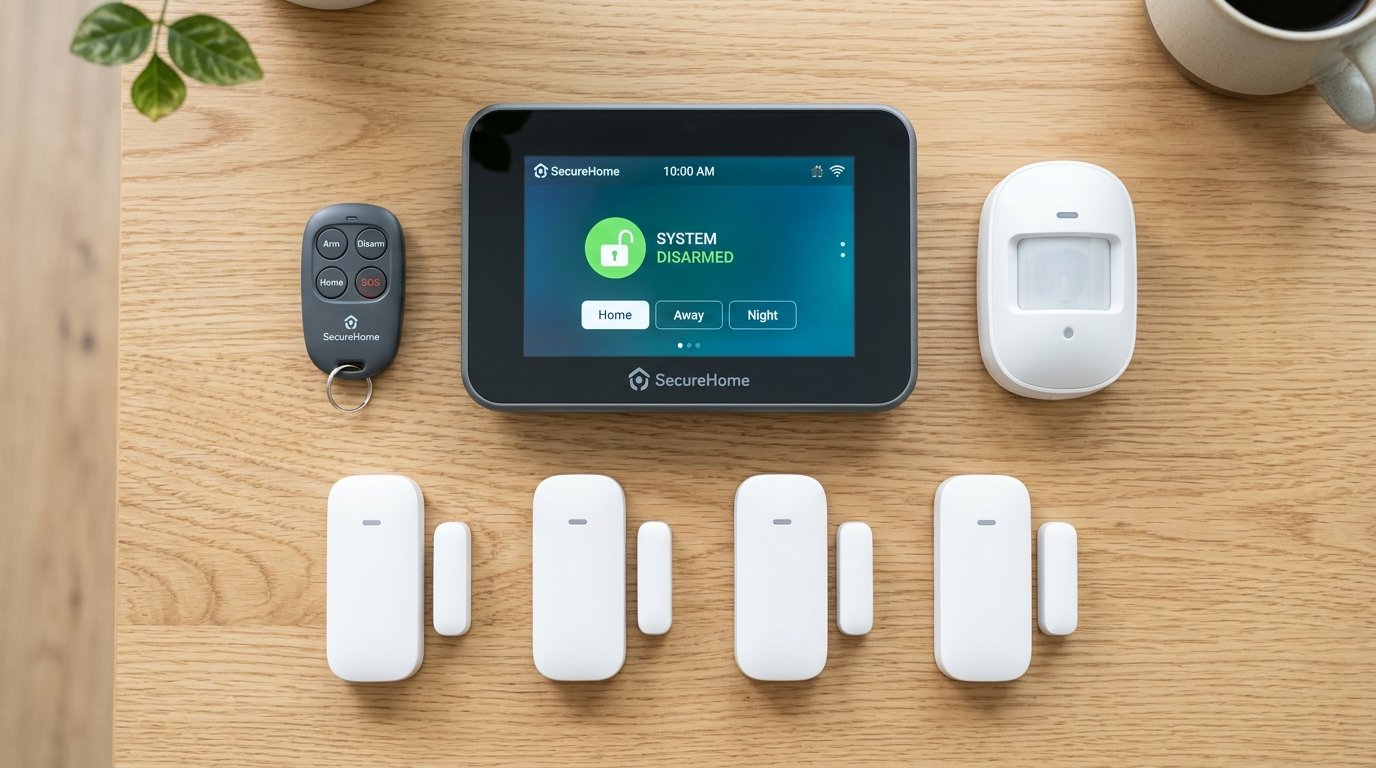
- 1. Equipment. Consumer pricing guides put a basic starter kit with a panel, a few entry sensors, and a motion detector at roughly $150 to $600. A fuller setup with cameras and smart devices commonly runs $600 to $2,000 or more, and large homes with extensive automation can exceed that.
- 2. Installation. Do it yourself and this is zero. Professional installation is reported anywhere from free with a contract up to about $299, with an average around $150, though complex installs on larger homes run considerably higher.
- 3. Monitoring. The recurring cost, and the one that matters most. Self-monitoring is typically free. Professional monitoring is commonly reported at $20 to $60 monthly, with feature-heavy plans reaching around $80.
- 4. The extras. Activation fees, cloud video storage per camera, service calls, alarm permits, and false alarm penalties. Our guide to choosing between providers covers these in detail, including the exact question to ask about each.
Want help working out what your home would actually cost?
Our advisors size a system to your home and compare real numbers across our provider partners, including total cost over the term. Free consultation, no pressure.
Call (855) 248-8052 or request a free quote online.What It Costs by Setup Size
Published 2026 pricing, grouped by the kind of setup rather than by provider. Treat these as planning ranges, not quotes, since actual pricing varies by home and location.
| Setup | Equipment | Monitoring | First-year total |
|---|---|---|---|
| Basic DIY, self-monitored | $150 to $300 | $0 | $150 to $300 |
| Basic DIY, monitored | $150 to $300 | $20 to $30/mo | $390 to $660 |
| Small home, professional | $400 to $700 plus install | $20 to $30/mo | $1,100 to $1,900 |
| Mid-size with cameras | $600 to $2,000 | $30 to $45/mo | $1,000 to $2,900 |
| Large or fully integrated | $2,000+ | $40 to $60/mo | $2,500 to $4,700+ |
Notice how much of the first-year total in the lower rows is equipment, and how much of it in the upper rows is monitoring. That shift is the whole story, and it gets more pronounced every year you own the system.
The Math That Actually Matters
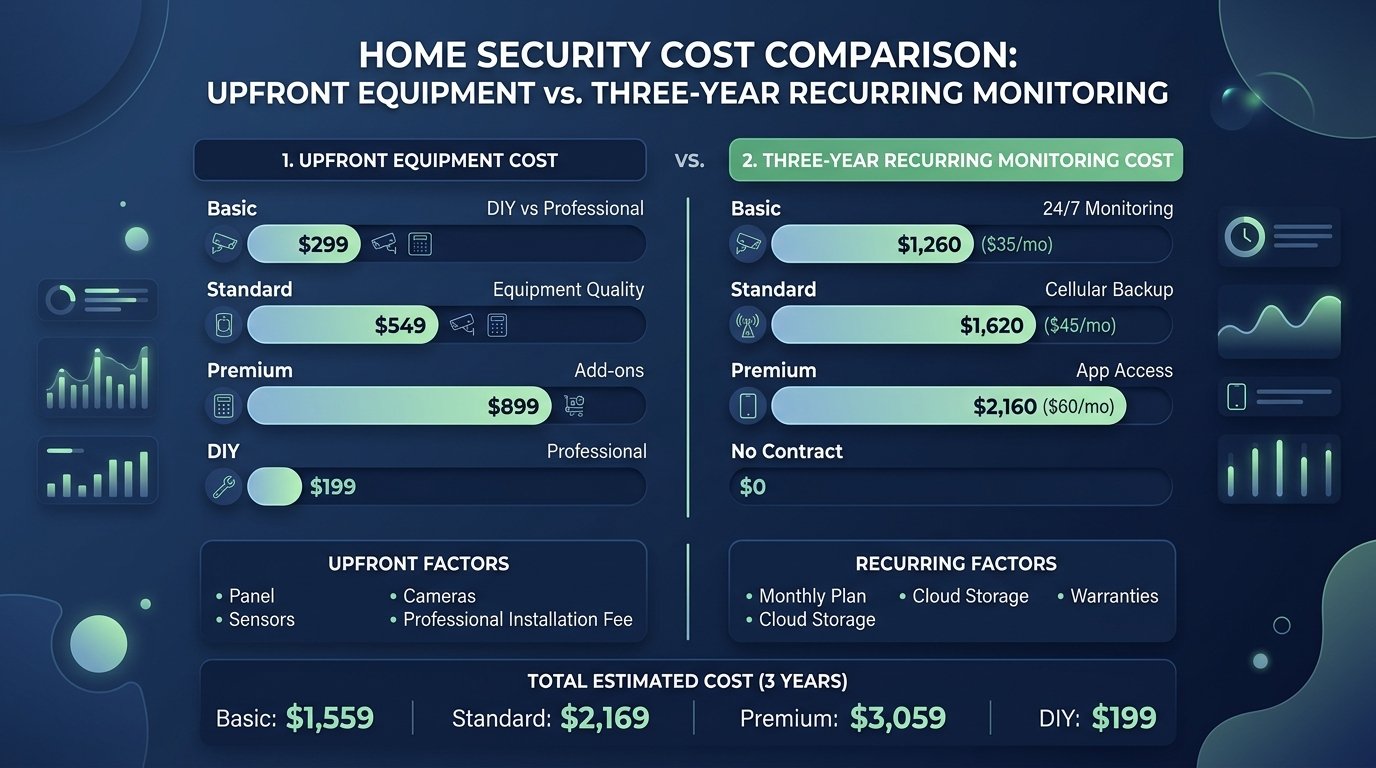
Here is the calculation that separates a cheap quote from a quote that only looks cheap. It takes two minutes and it works on any pair of offers.
Worked example
Quote A: equipment costs $250 more, monitoring is $20 per month.
Quote B: equipment is $250 cheaper, monitoring is $40 per month.
The $20 monthly difference costs $240 a year. That erases B's $250 equipment advantage in roughly twelve months, and keeps adding after that. Over three years, B costs about $470 more in total despite looking cheaper on day one.
Consumer pricing analysis makes the general point plainly: across a typical three-year ownership window, the recurring fee usually outweighs the upfront equipment by a wide margin.
Run it on your own quotes
- Multiply each monthly fee by 36 for a three-year view.
- Add the equipment cost and any one-time fees to each.
- Compare the two totals. That is your real answer.
This also explains why free equipment is not free. The hardware is financed through a higher monthly rate across the contract, which is a payment structure rather than a discount.
What Pushes Your Number Up or Down
Four factors move your cost more than anything else.
- Entry points, not square footage. Sensor count follows doors and accessible ground-floor windows. A compact home with many entry points can need more equipment than a larger, simpler one.
- Cameras. The fastest way to raise both numbers. Each camera adds hardware cost, and cloud video storage is often billed per camera per month.
- Monitoring tier. Self, professional, and interactive plans sit at different price points. Our guide to 24/7 professional monitoring explains what each tier actually delivers.
- Installation route. Doing it yourself removes the setup fee entirely. Our comparison of DIY versus professional installation covers when each is worth it.
Where You Can Genuinely Save
Not every saving is real, but these are.
- Self-install if your home is straightforward. This removes the setup fee, commonly reported around $99 to $199.
- Start with core coverage and add later. Entry sensors and a panel first, cameras once the basics are in place.
- Ask about paying monitoring annually. Some providers discount it, with reported savings around 16 percent, roughly two months free.
- Ask your insurer about a monitored-system discount before you choose a tier, since it may change the math.
- Choose month-to-month if you might move, which avoids termination fees entirely.
What is usually not a saving: accepting a longer contract purely for a lower monthly rate, without first running the three-year total.
Frequently Asked Questions
How much does a home security system cost on average?
Published 2026 figures put the national average around $600 to $750 total, with most homeowners spending $200 to $1,500 upfront plus roughly $20 to $60 monthly. Your entry-point count matters more than square footage.
What is the monthly cost of home security monitoring?
Self-monitoring is typically free. Professional monitoring is commonly reported at $20 to $60 per month, with feature-heavy interactive plans reaching around $80. This recurring fee usually outweighs equipment cost over time.
Is a home security system worth the cost?
That depends on your situation rather than the price alone. Weigh the monthly figure against what monitoring actually adds, and check whether your insurer offers a discount that offsets part of it.
Why is free equipment not actually free?
Because the hardware is financed through a higher monthly rate across the contract term. It is a payment structure, not a discount. Run the three-year total and you will usually see where the cost went.
Is DIY or professional installation cheaper?
DIY is cheaper upfront, removing a setup fee commonly reported around $99 to $199. Professional installation costs more initially but may suit complex homes. Compare total cost over three years, not just installation.
How much should I budget for a first system?
A basic monitored DIY setup commonly lands around $390 to $660 for the first year. A small professionally installed system typically runs $1,100 to $1,900 in year one, depending on equipment and monitoring tier.
Do security cameras add a lot to the cost?
They are the fastest way to raise both numbers. Each camera adds hardware cost, and cloud video storage is frequently billed per camera per month, so a multi-camera setup compounds on the recurring side.
Can I lower my monthly monitoring fee?
Sometimes. Ask about paying annually, since some providers discount it by around 16 percent. Also ask whether a lower tier covers what you need, and check for an insurance discount that offsets the cost.
Does a security system lower home insurance?
Many insurers offer a discount for monitored systems, though eligibility and amounts vary by insurer and location. Ask yours before choosing a monitoring tier, since it can change which option is cheapest overall.
How do I compare two security quotes fairly?
Multiply each monthly fee by 36, add equipment and one-time fees to each, then compare the totals. Quotes built on different equipment lists or term lengths cannot be compared on monthly rate alone.
Related Reading
- How to Choose Between Home Security Providers
- DIY vs Professional Home Security Installation
- What is 24/7 Professional Monitoring, and Is It Worth It?
- Buying Your First Home Security System
Explore our services:
Get a Second Opinion, Free
The cheapest quote and the cheapest system are often not the same thing. The difference usually shows up in year two.
Home Secure Connect is an independent home security advisor. We size systems to real homes and compare total cost across our trusted provider partners, not just the advertised monthly rate. Free consultation. No obligation. No pressure.
Call (855) 248-8052 or Request a Free QuoteAvailable Mon to Fri, 10am to 8pm ET.
Trending This Week
Smart Locks vs Traditional Deadbolts: Which Actua…
September 23, 2026 · About 8 min read
Alarm System vs Security System: What's the Diffe…
September 21, 2026 · About 8 min read
Home Security for Aging Parents: Practical Advice…
September 16, 2026 · About 9 min read