Quick Answer
In one sentence: Yes, signs and stickers deter some burglars, research on convicted offenders confirms it, but they work by signaling risk, so a sign is far more effective when there's a real system behind it than when it's standing alone.
The longer answer: This question gets two bad answers. Marketers say signs stop burglars cold; skeptics say they do nothing. The evidence sits between, and it's more useful than either. Studies that interviewed burglars directly show that most check for security before breaking in and many move on when they see it. A sign taps into that. But it deters by making a burglar believe the risk isn't worth it, and belief only carries so far against someone who tests it. This guide walks through what the research actually found and how to make a sign earn its place.
Key Takeaways
- Signs do deter some burglars, especially the opportunistic majority who make fast decisions.
- A sign works by signaling risk. The belief that a system is present is what deters, not the sign itself.
- A sign alone provides only deterrence. If a burglar proceeds or tests it, there's no detection or response.
- Signs are strongest backing a real system and paired with visible cameras and lighting.
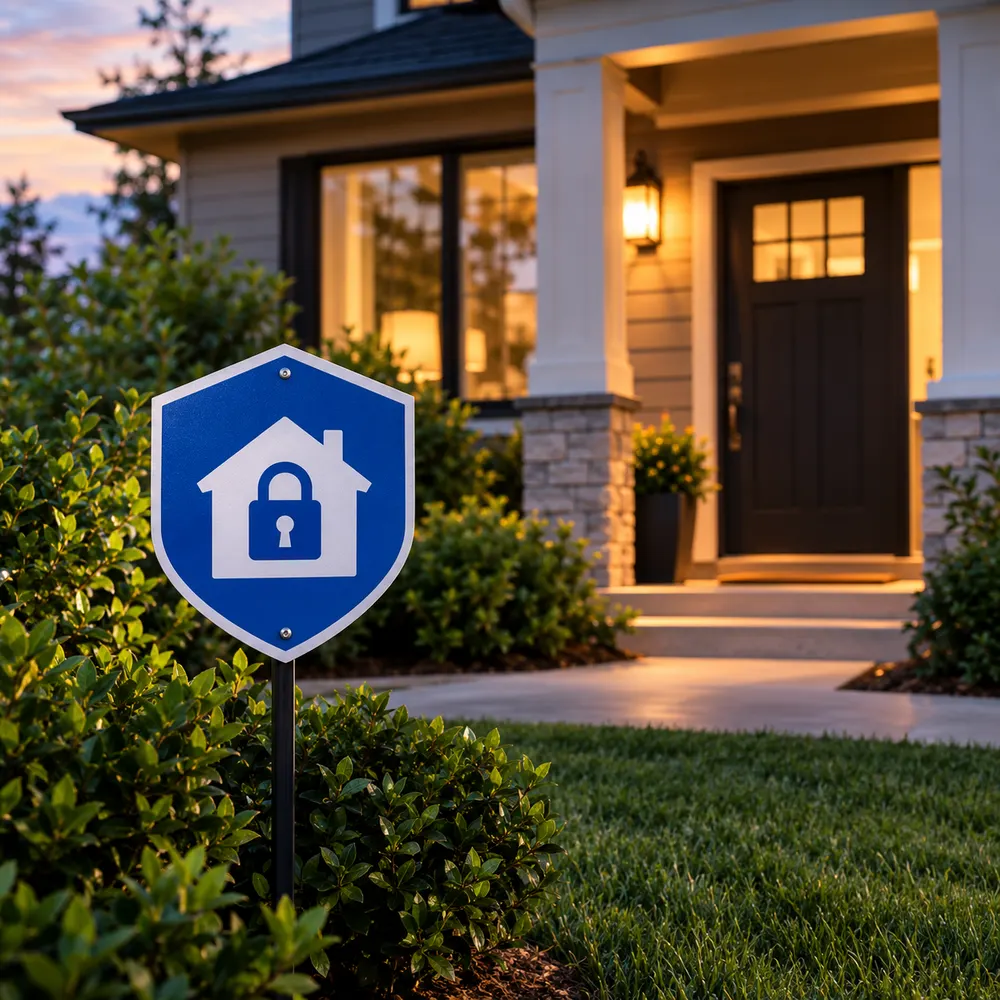
- Placement matters: a sign near the entrance is far more effective than one off at the curb.
A little yard sign or a window decal is the cheapest thing in home security, which is exactly why people are suspicious of it. Can a piece of plastic really change a burglar's mind? The honest answer, grounded in research that asked burglars themselves, is that it can, sometimes, and understanding when and why is the difference between a sign that helps and one that just decorates your lawn.
The Short Answer: Yes, but as a Signal
Signs are not magic and they are not useless. They are a signal, and signals work on some people and not others.
The reason a sign can work at all is that most residential burglary is opportunistic. Offenders are looking for an easy target and a fast, low-risk job, not a challenge. A sign raises the apparent risk of a particular house, and for a burglar comparing options, that can be enough to send them next door. But it's a nudge, not a wall, and how strong the nudge is depends heavily on whether the sign is backed by anything real. The psychology behind all of this is covered in our guide to how burglars choose homes.
What Convicted Burglars Actually Say
The most cited evidence comes from a study by the University of North Carolina at Charlotte, funded by an alarm-industry research foundation, that interviewed 422 incarcerated burglars across three states. A few findings stand out, and they're worth stating plainly.
Most check for security first. Around 83 percent said they would try to determine whether an alarm was present before attempting a break-in. They are actively looking for the signal a sign provides.
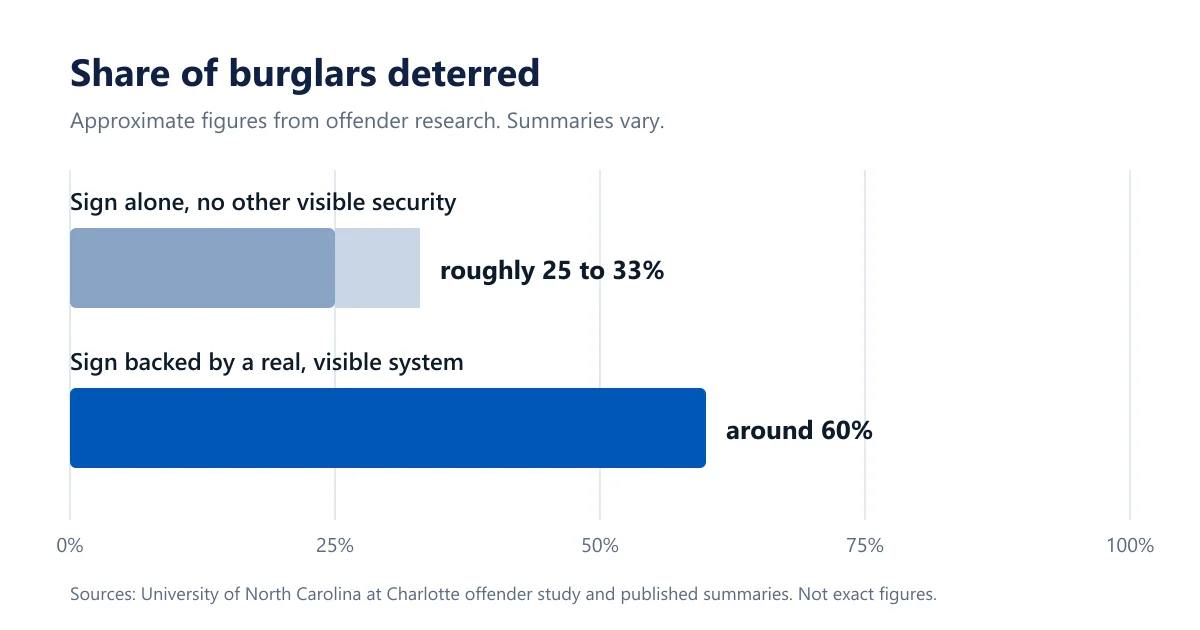
Many move on when they find it. About 60 percent said that if they discovered a system was in place, they would choose a different target, as study summaries report. That's a majority deterred by evidence of a real system.
A sign on its own does less. When researchers looked at signage alone, without other visible security, the deterrent effect was more modest, on the order of roughly a quarter to a third of burglars, according to a consumer security guide. Real and visible beats a lone sign, but a lone sign is not nothing.
Much of it is spur-of-the-moment. Around 41 percent described their break-ins as spontaneous. Those are exactly the offenders a visible deterrent is most likely to turn away, because they haven't committed to your house in particular.
Cameras, notably, scored higher than signs as a deterrent in the same research, which points to a theme we'll return to: the more real and visible the security looks, the stronger the effect.
How a Sign Works: It Sells Risk
Here's the mechanism, because it explains everything else. A sign does not physically stop anyone. It changes a calculation.
A burglar weighing a house is weighing risk, effort, and reward. They want speed, quiet, and an easy exit. A sign, a decal, a visible camera, all of it feeds one input: the perceived risk of getting caught. Crucially, it works on perception, not on whether an alarm is actually armed. The burglar can't see your subscription; they see the signal and price in the risk. That's why a sign can deter even when, in that moment, it's bluffing. And it's also why the bluff has limits: perception holds right up until someone decides to test it.
Want deterrence that holds up when it's tested?
Our advisors can help you build visible deterrence that's backed by something real, across our provider partners. Free consultation, no pressure.
Call (855) 248-8052 or request a free quote online.The Catch: A Sign Alone Only Deters
A sign does exactly one job: it deters. In the layered view of home security from our guide to alarms versus security systems, protection has five jobs, deter, detect, alert, respond, and document, and a sign covers only the first. That's the catch worth being clear-eyed about.
If deterrence fails, a sign has nothing left to offer. It doesn't detect the break-in, doesn't sound, doesn't call anyone, and doesn't record a thing. And deterrence can fail in a specific, costly way: a burglar tests the property, rattles a door, tries a window, and when no alarm responds, the sign is exposed as a bluff. Now it's worse than useless at that house, because the offender knows the truth, and that knowledge can be passed to others, a risk research summaries flag. A real system fails safe, sounding and alerting; a lone sign fails silent.
The Fake-Sign Question, Answered Honestly
This brings us to the popular shortcut: buy a sign for a few dollars, skip the system, and enjoy the deterrent for free. Does it work? Partly, and the honest picture has real caveats.
It can deter the casual offender. Against an opportunist who won't risk a maybe, a convincing sign can still send them elsewhere. That's genuine, if modest, value.
It gives you false confidence. The danger isn't only that it may fail; it's that you may skip real protection because you feel covered, a point security provider guidance makes. If a burglar proceeds, your losses can far exceed what a real system would have cost.
Experienced burglars often see through it. The offenders most apt to do their homework can spot a sign with no supporting cameras, no visible equipment, and no other cues, and read it as exactly what it is.
Branded signs you don't subscribe to carry a legal risk. Displaying a specific security company's trademarked sign when you're not a customer can create legal problems, as a consumer services guide notes. A generic 'this property is protected' sign avoids that, though it's also less specific as a bluff. This is general information, not legal advice.
The reasonable takeaway: a sign is a fine amplifier and a poor substitute. If visible deterrence matters enough to fake, it usually matters enough to make real.
How to Make a Sign Actually Work
Whether your sign backs a full system or a lighter setup, a few things sharpen its effect considerably.
Back it with something real. Even a modest genuine deterrent, a visible camera, a smart doorbell, changes the sign from a bluff into a true signal, and that's when the deterrent numbers climb.
Pair it with other visible cues. Research consistently finds signs work best combined with visible cameras, good lighting, and secure entry points, the same mix police guidance recommends. Our guide to visible outdoor cameras covers that layer, and monitoring adds another, as our guide to 24/7 monitoring explains.
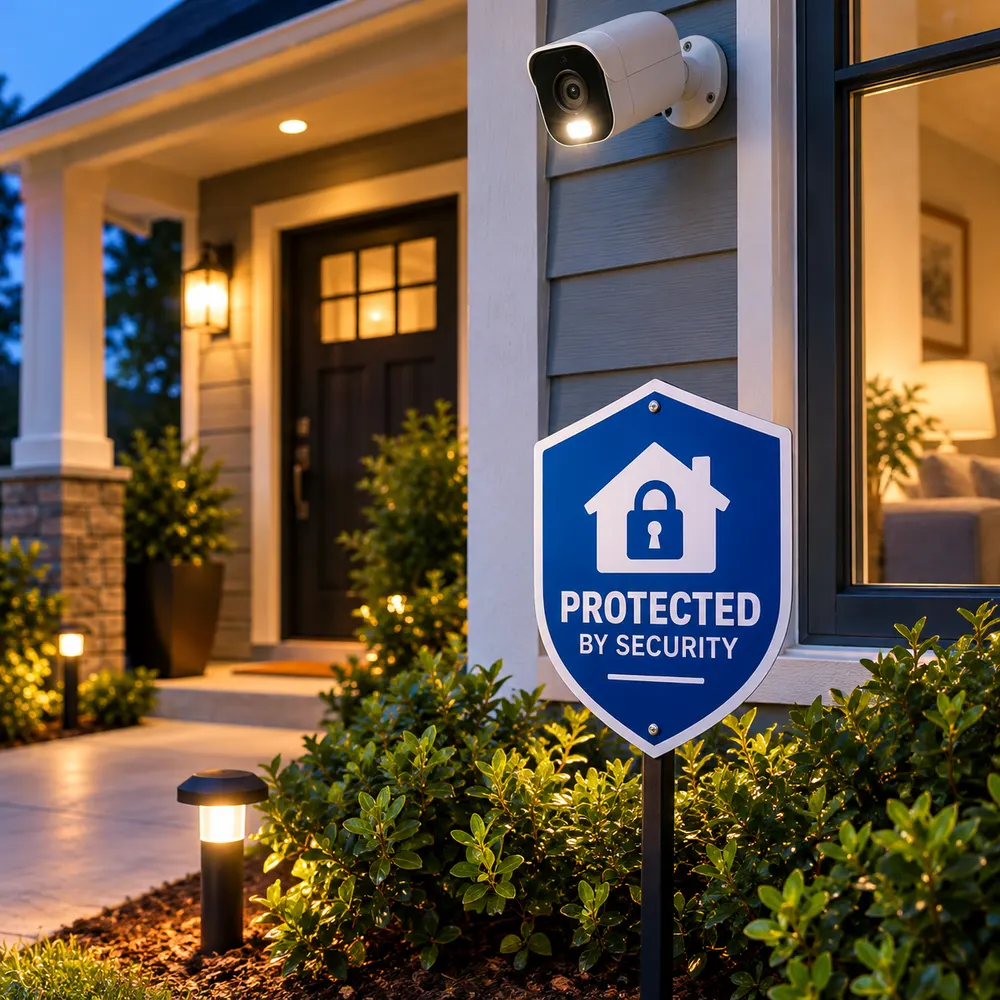
Place it where it's seen early. Placement matters more than people think. One university study, from the University of Texas at San Antonio, found signs near the front entrance were markedly more effective, by around a third, than signs off at the curb, according to a research summary. Put the signal where a burglar makes the decision: at the approach to the door.
Don't overdo it. A lawn crowded with mismatched signs can read as protesting too much. A clean, credible sign or two, plus visible real equipment, is more convincing than a cluttered display.
Frequently Asked Questions
Do home security signs really deter burglars?
Yes, some of them. Research interviewing convicted burglars found most check for security before breaking in and many move on when they see it. Signs work by signaling risk, though the effect is stronger with a real system behind them.
Do fake alarm signs work without a system?
Partly. A convincing sign can turn away a casual opportunist, but experienced burglars often spot a bluff, and you gain nothing if one proceeds. It also risks false confidence that leads you to skip real protection.
How much do signs alone reduce burglary risk?
In offender research, signage alone deterred on the order of a quarter to a third of burglars, less than a real, visible system, which deterred around 60 percent. A sign helps, but it is a nudge, not a guarantee.
Are cameras a better deterrent than signs?
Generally yes. In the same offender research, visible cameras deterred more burglars than signs alone, because they read as real, functioning security rather than a claim. Signs and cameras together are stronger than either by itself.
Is it illegal to put up a fake security sign?
A generic 'protected' sign is usually fine. Displaying a specific company's trademarked sign when you aren't their customer can create legal problems. If in doubt, use a generic sign or back a branded one with that company's real service.
Where should I place a security sign?
Near the entrance, where a burglar decides. One university study found signs by the front door were substantially more effective than signs placed far away at the curb. Put the signal where the target selection actually happens.
Why do signs work even if the alarm isn't on?
Because they work on perception. A burglar weighs the risk of getting caught, and can't see whether your system is armed. The visible signal raises perceived risk, which is what deters, at least until someone tests it.
What happens if a burglar tests my sign and nothing happens?
The bluff is exposed. If they rattle a door and no alarm responds, the sign loses its power at that house, and that knowledge can be shared. A real system, by contrast, sounds and alerts when tested.
Are signs enough on their own for home security?
No. A sign only deters; it doesn't detect, alert, respond, or record. It's a useful first layer, especially against opportunists, but it's not protection by itself. Treat it as an amplifier, not a substitute.
How can I make my security sign more effective?
Back it with real, visible security like a camera or doorbell, pair it with good lighting and strong locks, place it near the entrance, and keep the display clean and credible rather than cluttered with mismatched signs.
Related Reading
- How Do Burglars Actually Choose Which Homes to Break Into?
- Alarm System vs Security System: What's the Difference?
- Outdoor vs Indoor Security Cameras: Which Do You Actually Need?
- What is 24/7 Professional Monitoring, and Is It Worth It?
Explore our services:
A Sign Is a Promise. Keep It True.
A security sign is a small, cheap promise to a burglar that your home is a hard target. The research says that promise genuinely turns some of them away, and that it works best when it's not a bluff.
Home Secure Connect is an independent home security advisor. We help homeowners across the USA build visible deterrence that holds up when tested, backed by real equipment and, if you want it, monitoring, across our trusted provider partners. Free consultation. No obligation. No pressure.
Call (855) 248-8052 or Request a Free QuoteAvailable Mon to Fri, 10am to 8pm ET.
Trending This Week
Home Security When You Have a New Baby or Small K…
October 5, 2026 · About 9 min read
What to Do When Your Security System Sends a Fals…
September 30, 2026 · About 9 min read
Home Security for Apartments and Rentals: What Ac…
September 28, 2026 · About 9 min read