Quick Answer
In one sentence: Compare providers on contract length, equipment ownership, and total cost over the full term rather than on the advertised monthly rate, because that rate is the number most likely to change and the least likely to reflect what you actually pay.
The longer answer: Most providers sell comparable hardware. What genuinely differs is the agreement wrapped around it: how long you're committed, whether you own the equipment at the end, what happens if you move, and what it costs to leave. This guide covers the clauses to read before signing and the questions that surface answers providers don't volunteer.
Key Takeaways
- Compare total cost across the full term, not the advertised monthly rate.
- Most providers lease equipment, so you may own nothing at the end. Confirm in writing.
- Early termination fees can run up to the entire remaining balance, per industry cost reporting.
- Contracts commonly cap provider liability around $500 and state the provider is not your insurer.
- Auto-renewal is common, and cancelling after a renewal can trigger the termination fee again.
The equipment is the easy part. Sensors detect doors opening, cameras record, panels arm and disarm, and across the market these work in broadly similar ways. What separates a good decision from a regrettable one is almost entirely contractual. If you've already worked through DIY versus professional installation, this is the next decision, and here's how to make it on evidence rather than on a sales call.
What Actually Differs Between Providers
Strip away the marketing and providers differ meaningfully on six things. Compare these and you've compared what matters.
- Contract length. Month-to-month through multi-year terms, commonly 12 to 36 months. Longer often buys a lower rate and costs you flexibility.
- Equipment ownership. The one most people get wrong. Consumer security guidance notes most providers lease, so you own nothing when the term ends unless you pay to buy it.
- Total cost over the term. Monitoring commonly runs $15 to $60 or more monthly depending on features. Multiply by the term, add fees, and compare that number.
- Monitoring quality. Whether the center is UL-listed, whether cellular backup is included, and whether a second center takes over if the first goes offline.
- What happens when you move. Some agreements transfer, some charge a relocation fee, and professionally installed equipment may stay with the property.
- Exit terms. Notice required, cancellation fee, and whether the agreement renews automatically. This is where a bad fit gets expensive.
The Contract Clauses Most People Never Read
Two clauses appear in nearly every home security agreement. Both are standard industry practice, and almost nobody reads them until something has gone wrong.
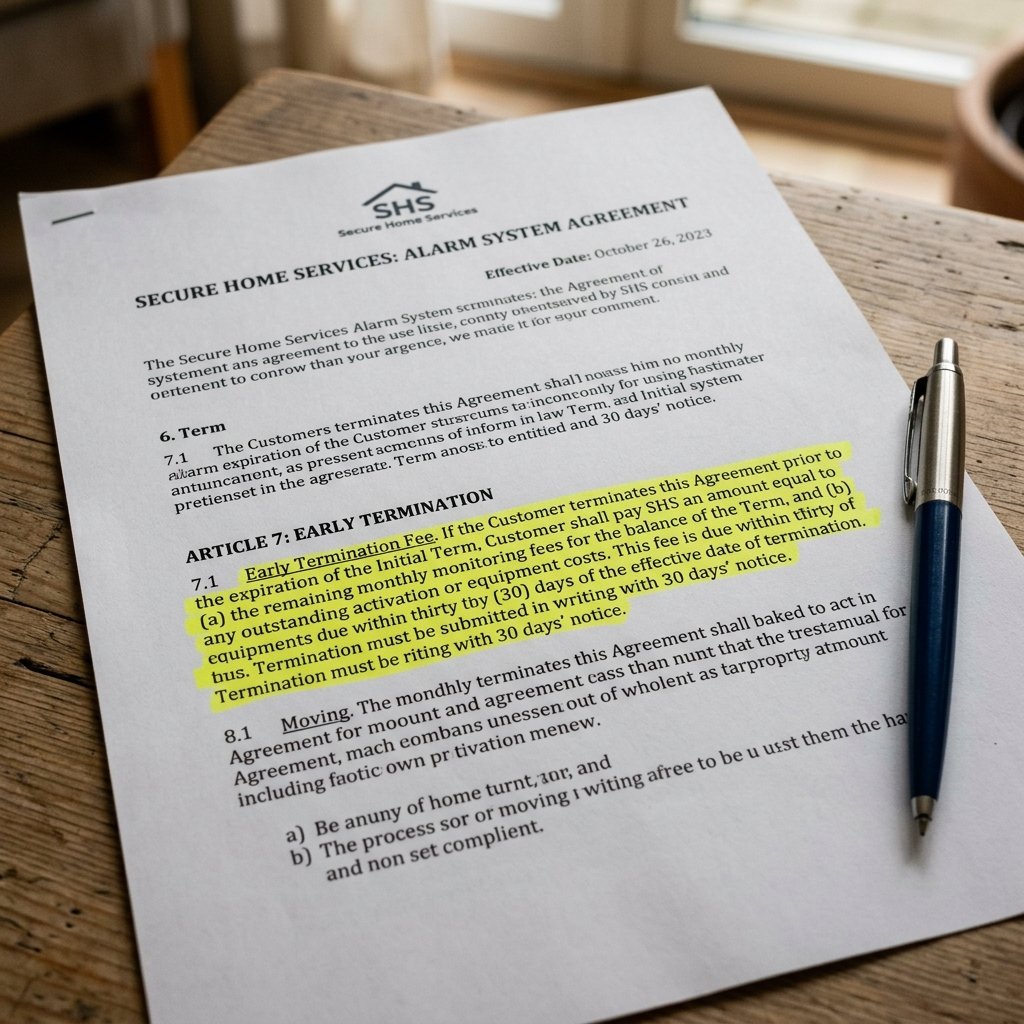
Limitation of liability
Security industry contract guidance describes a standard clause capping what your provider pays if a loss occurs, frequently around $500. If your home is burglarized and the system fails, that cap is typically the ceiling on the provider's exposure, not the value of what was taken.
The provider is not your insurer
The same guidance notes standard language clarifying that an alarm company does not act as your insurer and has no obligation to cover losses. Your homeowner or renter policy covers losses. The system's job is to deter, detect, and summon help.
Why this matters: you are not buying a guarantee against loss. You are buying detection and response. Judge providers on how well they do that.
Two more worth finding. Agreements frequently renew automatically, and industry cost reporting notes that cancelling after a renewal can trigger the termination fee again on the new term, so find the cancellation window and set a reminder before it. Some agreements also allow the monthly rate to rise during the term, with reported annual increases of roughly 2 to 5 percent. Ask whether you have any right to object in writing and exit without penalty, since some agreements include that protection.
The Costs That Don't Appear in the Quote
Compare on total cost, not monthly rate. Each line below commonly sits outside the headline number. Ranges are publicly reported industry figures and vary by provider and location.
| Cost line | Reported range | Ask this |
|---|---|---|
| Activation fee | Up to about $230 | Is activation charged, and is it waived with any offer? |
| Early termination | Up to the full remaining balance | If I cancel in month 6 of a 36 month term, what do I owe? |
| Cloud video storage | About $3 to $15 per camera monthly | Is storage included, and does it change per camera? |
| Service call fee | About $50 to $200 | What does a technician visit cost after installation? |
| Annual price increase | Reported at about 2 to 5 percent | Can my rate rise during the term, and by how much? |
| Permits and false alarm fines | About $25 to $100 yearly, fines $50 to $500 or more | Does my city require a permit, and who files it? |
Permit requirements and false alarm penalties are set locally, so check with your municipality rather than relying on a provider's summary.
Want someone to read the terms with you before you sign?
Our advisors compare options across our provider partners and explain contract terms in plain language. Free consultation, no pressure.
Call (855) 248-8052 or request a free quote online.Ten Questions to Ask Every Provider
Ask all ten of every provider and write the answers down. Consistency is what makes a comparison meaningful.

- How long is the contract, and do you offer month-to-month?
Establishes the commitment before anything else. - Do I own the equipment at the end, or is it leased?
The most common misunderstanding in the industry. - What is my total cost over the full term, including every fee?
Forces one comparable number instead of a monthly rate. - Can my rate increase during the contract, and by how much?
Small annual increases compound over a multi-year term. - What exactly do I pay if I cancel in month six?
A specific scenario gets a specific answer. Vagueness is informative. - Does the agreement auto-renew, and what is the cancellation window?
Determines whether you need a reminder to avoid another full term. - Is the monitoring center UL-listed, and is there a backup center?
Certification is what most insurers require. Redundancy keeps monitoring working during an outage. - Is cellular backup included or an add-on?
Without it, a cut line or outage can take the system offline. - What happens if I move mid-contract?
Transfer terms and relocation fees vary widely. - Will you send me the full agreement to read before I sign?
The most important question here. A refusal is the answer.
No legitimate provider should object to you reading the full agreement at your own pace. Pressure to sign during the visit is a sales technique, not a service standard.
The Real Math on a Free Equipment Offer
Free equipment offers are common and not automatically bad. Some genuinely deliver value. The point is to check rather than assume.

- Multiply the monthly monitoring rate by the number of months in the term.
- Add every one-time fee: activation, installation, anything else on the quote.
- That total is the true cost of the free equipment offer.
- Now price the alternative: a no-contract monitoring rate over the same months, plus buying comparable equipment outright.
- Compare. If the contract total is higher, the equipment was not free. You financed it through the monitoring rate.
This approach appears in industry cost analysis and gives you a concrete number to negotiate with.
Red Flags Worth Walking Away From
- Pressure to sign during the first visit, or an offer that expires the same day
- Reluctance to provide the full written agreement before signing
- Vague or shifting answers about equipment ownership
- An unsolicited visit claiming your current provider was acquired or went out of business, which is worth verifying independently before agreeing to anything
- A quoted monthly rate with no written breakdown of one-time fees
- Any suggestion that a system guarantees you won't be burglarized, which the contract itself will contradict
Frequently Asked Questions
What should I compare first when choosing a home security provider?
Contract length, equipment ownership, and total cost over the term. These shape the decision more than hardware differences. The advertised monthly rate is the least reliable basis, since it often excludes fees.
Do I own my home security equipment?
Often not. Most providers lease equipment, so it stays theirs when the contract ends. Some let you buy it for an added fee. Ask directly and get the answer in writing.
How much is a home security early termination fee?
It varies widely. Industry cost reporting indicates some providers charge up to the entire remaining balance, others a percentage. Ask for the amount tied to a specific scenario, such as cancelling in month six.
Can a home security company raise my price mid-contract?
Some agreements permit it, with reported annual increases of roughly 2 to 5 percent. Ask whether your rate can change and whether you can object or exit if it does. Some agreements include that protection.
Are no-contract home security options any good?
Yes, and they suit many households. Month-to-month plans avoid early termination fees entirely. The trade-off is that longer contracts sometimes carry lower monthly rates or bundled equipment.
What does a limitation of liability clause mean?
It caps what the provider pays if a loss occurs, commonly around $500 per industry contract guidance. A security company sells detection and response, not insurance. Your homeowner or renter policy covers stolen property.
Is my provider responsible if my home is burglarized?
Generally not for the loss itself. Standard agreements state the provider is not acting as your insurer. The system and your insurance policy do different jobs, which is why both matter.
What questions should I ask before signing a security contract?
At minimum: contract length, equipment ownership, total cost, cancellation fee, auto-renewal terms, whether the rate can rise, and what happens if you move. Always ask for the full agreement in writing first.
Should I get quotes from more than one provider?
Yes. Comparable quotes only exist if you ask each provider the same questions and record the answers. Two quotes assuming different term lengths or ownership models are not actually comparable.
What if a salesperson says my current provider went out of business?
Verify independently before agreeing to anything. Contact your existing provider using a number from your own paperwork, not one supplied at the door. Do not sign during an unsolicited visit.
Related Reading
- How Much Does a Home Security System Really Cost?
- Buying Your First Home Security System: The Five Places People Get Stuck
- DIY vs Professional Home Security Installation
- What is 24/7 Professional Monitoring, and Is It Worth It?
- Do You Actually Need a Home Security System?
Explore our services:
Get a Second Opinion, Free
The hard part of choosing a provider is that you're comparing sales presentations, not equivalent information. A method fixes that.
Home Secure Connect is an independent home security advisor. We compare options across our trusted provider partners and explain contract terms in plain language, including the parts that are easy to miss. Free consultation. No obligation. No pressure.
Call (855) 248-8052 or Request a Free QuoteAvailable Mon to Fri, 10am to 8pm ET.
Trending This Week

Contract vs No-Contract Home Security: Which Actu…
September 2, 2026 · About 7 min read
Fire Safety at Home: What Your Smoke Alarm Isn't …
August 31, 2026 · About 8 min read
What Modern Home Security Does That Old Systems D…
August 26, 2026 · About 8 min read