Business Internet & Phone:
Built For What Happens When Your Connection Can't Fail
Home Secure Connect helps small and mid-sized businesses find dedicated business internet, hosted VoIP, multi-line phone systems, and compliance-ready communication solutions from our trusted business provider partners. Real SLAs. Real support. Honest advice from an independent advisor.
Business internet isn't just faster residential internet. It's built for reliability.
Every hour of downtime costs your business. Customers who can't reach you. Card readers that stop working. Cloud apps that go dark. Employees standing idle. For a 20-person business, an hour of outage typically costs $2,000 to $10,000 in lost productivity and revenue. That's why business internet exists as a different product from residential internet: it comes with a Service Level Agreement (SLA) guaranteeing uptime, business-tier support that answers within minutes not days, and often a dedicated connection that isn't shared with your residential neighbors during peak use.
The same logic applies to business phone systems. A dropped call to a potential customer isn't a minor annoyance, it's lost revenue. This page walks through business internet and phone options from our provider partners, including where the real differences between business-tier and consumer-tier service actually matter for your operation, and where a residential-plus-VoIP setup might be enough. Honest advice, no pressure to upsell what you don't need.
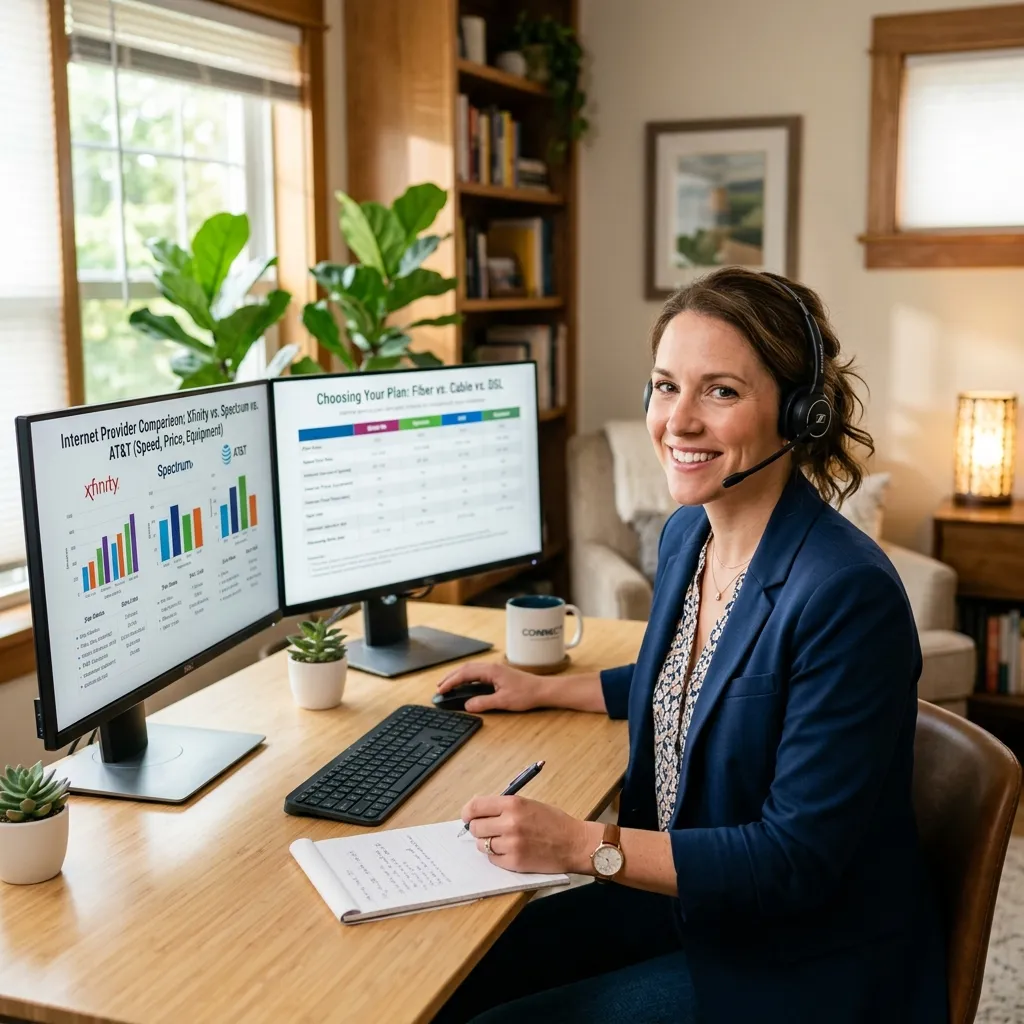
Business Internet vs Residential Internet: What Actually Differs
Business internet costs more than residential for specific reasons. Here's what you're actually paying for.
| Feature | Residential | Business-Tier |
|---|---|---|
| Uptime SLA | None. Best-effort service. | Typically 99.9% to 99.999% (five nines = under 6 min downtime/year), with service credits if breached. |
| Support Response | Consumer queue. Hours to days. | Priority queue. Often minutes to a few hours. |
| Static IP Address | Dynamic IP (changes). | Static IP available. Required for VPN, servers, remote access. |
| Symmetric Speeds | Asymmetric (fast down, slow up). | Symmetric on business fiber (same fast speed both ways). |
| Dedicated Line | Shared with neighbors. | Dedicated options available (higher cost, guaranteed bandwidth). |
Honest note: Not every business needs business-tier internet. A 3-person consulting firm working from home offices may be fine on residential plans. A retail store processing card payments, a medical practice running compliance-sensitive apps, or a call center with 20 employees on video calls likely isn't.
Business Phone System Options: Hosted VoIP, On-Premise PBX, & Traditional Lines
Three main technology paths for business phone service. Honest framing on when each makes sense.
Hosted VoIP / Cloud PBX
Your phone system runs in the provider's cloud. Employees make and receive calls through desk phones, softphone apps on laptops, or mobile apps.
Typical Pricing
$15 to $50 per user/month (standard)
$50 to $75 per user/month (premium)
Key Benefits
Fast setup, no hardware maintenance, and effortless scaling as you grow.
Best for: Small and mid-sized businesses (under 100 employees), remote/hybrid workforces, and any business wanting predictable monthly costs without upfront hardware investment.
On-Premise PBX
Traditional PBX hardware installed and maintained at your office. Upfront hardware cost: $500 to $2,000+ per user (a 20-user system runs $15,000 to $40,000 installed), plus 15 to 20 percent of hardware cost annually for maintenance.
Best for: Businesses with dedicated IT staff, specific compliance requirements that mandate on-premise infrastructure, or 100+ employee businesses with stable long-term staffing.
Traditional Business Landlines
Copper-based multi-line phone service from a traditional telephone company. Typical pricing: $50 to $100 per line per month, which is 2 to 5 times more expensive than equivalent VoIP.
Best for: Very small businesses (1-3 lines) in areas with unreliable internet, businesses with specific analog fax needs, or businesses currently under a legacy contract.
What Business-Tier Support Actually Gets You
Support is where business-tier service most visibly justifies its price difference.
Response time guarantees
Business-tier support typically guarantees response within 30 minutes to 2 hours for critical issues, versus consumer support that often runs hours to days. For a business losing $2,000+ per hour to downtime, faster response is the entire value proposition.
Direct escalation paths
Business plans often include a named account manager or direct line to senior technical support. Consumer support routes through general queues and requires re-explaining the situation each time.
Service credits when SLAs are breached
Business SLAs (99.9 percent or better) typically include automatic service credits when uptime falls below the guarantee. A 99.999 percent SLA means less than 6 minutes of downtime per year. If your provider exceeds that, you get money back.
On-site support options
For critical business functions (retail card readers, medical office phones, call centers), on-site technician response within the same day or next business day is often available. Consumer plans don't include this.
What Business Internet and Phone Actually Cost in 2026
Industry-verified pricing ranges. Specific quotes from our business provider partners are given during your free consultation.
| Service | Typical Monthly Cost | Notes |
|---|---|---|
| Business Fiber Internet | $80 to $500+ | Speed and SLA tier determine cost. 1 Gig symmetric plans typically $100-$300/month. |
| Business VoIP (Basic) | $15 to $30 per user | Unlimited domestic calling, voicemail, mobile app. |
| Business VoIP (Premium) | $50 to $75 per user | Call center features, advanced analytics, CRM integrations, premium support. |
| Traditional Business Landline | $50 to $100 per line | Legacy pricing. 2-5x more expensive than equivalent VoIP. |
| Business Desk Phones | $80 to $250 each (one-time) | Optional. Softphone apps on existing computers work well as an alternative. |
Additional Fees to Expect
E911 fees typically $0.20 to $2.00 per line, Universal Service Fund fees 5 to 15 percent of the bill, and various state and local taxes. Number porting fees $10 to $30 per number (many providers waive this). Setup and installation ranges from $0 (self-install) to $200 to $500 (professional on-site). A 10-person office typically runs $150 to $350 per month total for a full-featured VoIP system, versus $500 to $800 for a comparable traditional phone setup.
Compliance Considerations by Industry
Some industries have specific compliance requirements for business communications. Honest overview of what to look for.
Talk to a Compliance Expert HIPAA compliance
(healthcare)
If your business handles Protected Health Information (PHI) by phone, your business phone system needs to support HIPAA compliance: end-to-end encryption, Business Associate Agreements (BAAs) from the provider, secure voicemail transcription, and configurable call recording retention. Not every VoIP provider offers this.
PCI compliance
(payment processing)
Businesses that process card payments over the phone need PCI-compliant call handling. Look for providers that support call pause/resume during payment collection, secure card entry via IVR, and appropriate audit logging.
Call recording compliance
Federal and state laws vary on call recording consent. Some states require two-party consent (you must notify the caller). Business VoIP systems can automate consent notifications and manage retention policies, but you're still responsible for the underlying compliance.
GDPR and state privacy laws
Businesses with international customers or California/Virginia/Colorado residents may face additional privacy compliance requirements around call data retention. Business VoIP providers vary in how they handle this. Worth confirming during your evaluation.
Why Home Secure Connect for Business Services
We put your business's reliability and budget first.
Multi-Provider Business Comparison
We compare business internet, VoIP, and phone system options across our business provider partners so you see the real trade-offs, not one carrier's pitch.
Honest Business-Tier vs Residential Advice
Sometimes your business genuinely needs business-tier service with SLA. Sometimes residential-plus-VoIP is fine. We tell you which.
Compliance-Aware Recommendations
For healthcare, retail, and finance businesses, we help identify providers with the specific compliance certifications you need (HIPAA, PCI, and others).
Independent Advisor, Not a Reseller
We recommend the right provider for your business, not the one that pays the highest commission. Free consultation.
Frequently Asked Questions
Find the Right Business Internet & Phone For Your Operation
Talk to a business advisor about dedicated internet, hosted VoIP, multi-line phone systems, SLA guarantees, and compliance requirements. We compare business provider options honestly and tell you when business-tier is worth the price and when residential-plus-VoIP would serve you fine. Free consultation. No pressure.
Mon to Fri, business hours.